Tommaso Marrocchesi Marzi, dapper in a three-piece, pin-striped suit, is pouring his wines at the Cheese Cellar, at the foot of the Space Needle. He and his brother, Federico, are the fifth generation of the family-owned Tenuta di Bibbiano estate in the Chianti Classico hills of Tuscany, midway between Florence and Siena.
It's a 500-acre estate in the rolling hills of Tuscany, full of olive trees and vineyards. Young Tommaso, with a degree in business and economics, has been in charge for the past 12 years.
From the 50 vineyard acres in production, Bibbiano produces roughly 10,000 cases of wine, the best part being about 15,000 bottles a year of Chianti Classico Riserva from the vineyard called Vigna del Capannino. It's named for the family's shooting blinds on the steep hillside; grandpa, it seems, liked to bang away at pigeons.
The wines are what you'd expect of long-established Chianti Classico vines: the rich, plummy flavors of Sangiovese Grosso grapes, 16 months of oak aging, a textbook Chianti Classico. What's unexpected is the price: $28. It could be the best bargain in Seattle.
PaninoPanini
Sweet & Savory Words About Italy, Baked Fresh Daily
Saturday, May 19, 2012
Chianti Classico: Italian reserve
Labels:
chianti,
chianti classico,
Italy,
tuscany,
wine
| Reactions: |
Thursday, May 17, 2012
The Godfather moves on. Ciao, Luciano!
It was mid-morning on a Tuesday, and Luciano Bardinelli had just lit
his first cigar of the day, On Sunday, Mother's Day, he'd served a full
house; on Monday, he'd packed up his files and belongings. After a
lifetime as an owner, headwaiter, manager, occasional line cook, waiter,
busboy, Luciano was not going to work in one of his own restaurants.
"My first day as a free man."
Luciano (no one calls him Signor Bardinelli for long) had come to Seattle exactly 30 years ago, in 1982. There was no Tom Douglas, no Ethan Stowell. There were no websites to chronicle the comings and goings of platoons of energetic young chefs, no Eater.com, no Voracious, no ChowHound.
Born on the shores of Lago Maggiore, in the northern Italian Alps, Luciano had already managed exclusive restaurants and private clubs in Las Vegas and the Hollywood Hills. One fine autumn day in 1981 he happened to pay a call on a friend in Seattle, and found that the landscape of red and yellow leaves reminded him of home. Within months, he had left the desert and driven to Seattle, the radio of his U-Haul tuned to the Kentucky Derby. ("The winner was a long shot named Gato del Sol," he recalls.)
Luciano became the Godfather to Seattle's Italian restaurant renaissance. He was not a chef by training or temperament; his strong suit was Armani (topped these days by a full head of white hair), served with an urbane elegance. French was the cuisine of prestige back then, but Settebello, his first Seattle restaurant, on Capitol Hill was decidedly Italian. Not low-brow, Spaghetti House meatballs-in-red-sauce but classy, suave northern Italian: osso buco, agnolotti stuffed with veal, tiramisu. In the course of its ten-year run, it changed the way Seattle thought about food--not just Italian food, but restaurant food in general.
One of his cooks was Scott Carsberg, who'd fallen in love with Italian food, and went on to start Lampreia and Bisato; he's the exception: a chef who really knows and understands Italian cooking. A mutual friend says, "Luciano has a point when he says that these Americans go to Italy for three months and think they know how to make pasta and cook Italian food. The soba masters in Japan study the art of making noodles for 15 years, and then spend the next 30 perfecting it. You can't just order it frozen from California." In an interview for the Seattle Times five years ago, Carsberg returned the compliment: "Luciano was the best front man in the Italian genre. He brought modern Italian cuisine to Seattle."
Vancouver, BC, had a similarly gregarious Italian promoter named Umberto Menghi, who'd started building a restaurant empire ten years earlier. Word got around, and pretty soon Umberto sent down his associate, Carmine Smeraldo, to open an outpost in Pioneer Square. Umberto withdrew within a couple of years but Carmine remained; he and Luciano became best friends.
"Carmine and I were the same age. We were like brothers," Luciano told me this week. "After he died in January, I thought, it's time to scale down and do something else." (There's a third "brother," Raffaele Calise, who's still working at Picolino's in Ballard.)
What Luciano has been doing for three decades, of course, was opening and running restaurants. A string of them after Settebello: Stresa, Sans Souci, Italianissimo, among others. Sometimes he'd become a minority partner and help out a friend; sometimes he'd make bad bets on a location or a concept; sometimes he'd become distracted by marital problems. His last place, Ristorante Luciano, had a great location, Bellevue Square; a landlord, Kemper Freeman, with a reputation for being hard-nosed; and a clientele of Yelpers quick to complain about high prices and a mis-fired dish.
"I owed a lot of money, but Mr. Freeman released me. And he gave me a going-away party. He paid for 60-70 people." In attendance: Eastsiders who'd been coming to the restaurant regularly, along with a few Seattle diners who'd remained loyal.
At Bellevue Square, a new tenant is already lined up: Spice Route Cuisine, a mid-market Indian restaurant, currently at Crossroads. As for Luciano, after taking some time off for a trip back to Italy, he'll resettle in Morro Bay, Calif., where he has his eye on a little house (the Beach House Bistro) overlooking the Pacific. "Twenty seats, retired people who come in two-three times a week. I'll go to the market for produce and fish and fix a fresh menu every day." He hopes to be open by mid-summer.
Luciano (no one calls him Signor Bardinelli for long) had come to Seattle exactly 30 years ago, in 1982. There was no Tom Douglas, no Ethan Stowell. There were no websites to chronicle the comings and goings of platoons of energetic young chefs, no Eater.com, no Voracious, no ChowHound.
Born on the shores of Lago Maggiore, in the northern Italian Alps, Luciano had already managed exclusive restaurants and private clubs in Las Vegas and the Hollywood Hills. One fine autumn day in 1981 he happened to pay a call on a friend in Seattle, and found that the landscape of red and yellow leaves reminded him of home. Within months, he had left the desert and driven to Seattle, the radio of his U-Haul tuned to the Kentucky Derby. ("The winner was a long shot named Gato del Sol," he recalls.)
Luciano became the Godfather to Seattle's Italian restaurant renaissance. He was not a chef by training or temperament; his strong suit was Armani (topped these days by a full head of white hair), served with an urbane elegance. French was the cuisine of prestige back then, but Settebello, his first Seattle restaurant, on Capitol Hill was decidedly Italian. Not low-brow, Spaghetti House meatballs-in-red-sauce but classy, suave northern Italian: osso buco, agnolotti stuffed with veal, tiramisu. In the course of its ten-year run, it changed the way Seattle thought about food--not just Italian food, but restaurant food in general.
One of his cooks was Scott Carsberg, who'd fallen in love with Italian food, and went on to start Lampreia and Bisato; he's the exception: a chef who really knows and understands Italian cooking. A mutual friend says, "Luciano has a point when he says that these Americans go to Italy for three months and think they know how to make pasta and cook Italian food. The soba masters in Japan study the art of making noodles for 15 years, and then spend the next 30 perfecting it. You can't just order it frozen from California." In an interview for the Seattle Times five years ago, Carsberg returned the compliment: "Luciano was the best front man in the Italian genre. He brought modern Italian cuisine to Seattle."
Vancouver, BC, had a similarly gregarious Italian promoter named Umberto Menghi, who'd started building a restaurant empire ten years earlier. Word got around, and pretty soon Umberto sent down his associate, Carmine Smeraldo, to open an outpost in Pioneer Square. Umberto withdrew within a couple of years but Carmine remained; he and Luciano became best friends.
"Carmine and I were the same age. We were like brothers," Luciano told me this week. "After he died in January, I thought, it's time to scale down and do something else." (There's a third "brother," Raffaele Calise, who's still working at Picolino's in Ballard.)
What Luciano has been doing for three decades, of course, was opening and running restaurants. A string of them after Settebello: Stresa, Sans Souci, Italianissimo, among others. Sometimes he'd become a minority partner and help out a friend; sometimes he'd make bad bets on a location or a concept; sometimes he'd become distracted by marital problems. His last place, Ristorante Luciano, had a great location, Bellevue Square; a landlord, Kemper Freeman, with a reputation for being hard-nosed; and a clientele of Yelpers quick to complain about high prices and a mis-fired dish.
"I owed a lot of money, but Mr. Freeman released me. And he gave me a going-away party. He paid for 60-70 people." In attendance: Eastsiders who'd been coming to the restaurant regularly, along with a few Seattle diners who'd remained loyal.
At Bellevue Square, a new tenant is already lined up: Spice Route Cuisine, a mid-market Indian restaurant, currently at Crossroads. As for Luciano, after taking some time off for a trip back to Italy, he'll resettle in Morro Bay, Calif., where he has his eye on a little house (the Beach House Bistro) overlooking the Pacific. "Twenty seats, retired people who come in two-three times a week. I'll go to the market for produce and fish and fix a fresh menu every day." He hopes to be open by mid-summer.
Labels:
Luciano Bardinelli,
restaurants,
Seattle
| Reactions: |
Saturday, May 12, 2012
Glamor on the Mediterranean
Ya gotta hand it to the Italians: no sooner do they crash a fancy boat
but they get their folks to buy another one. You remember the Costa Concordia,
no doubt. The house arrest of the skipper, Francesco Schettino, was
just reconfirmed by a magistrate, while the investigation into crew
members and company execs drags on. But that didn't stop the Costa
Crosciere line (owned by Carnival Cruises, in case you forgot) from
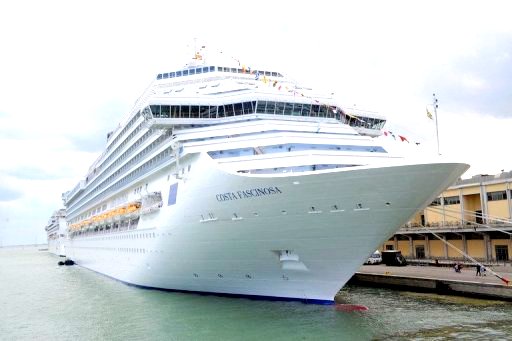
launching a fancy new replacement, the Costa Fascinosa, in Venice this morning. The president of the company told well-wishers that bookings are back to normal. The Fascinosa is every bit as large and luxurious (114,500 gross tons, 3,780 passengers) as its ill-fated class-mate, the Concordia.
Italy's tourism minister, Piero Gnudi, was on hand for the launch. He said that tourism can help Italy create 1.6 million jobs over the next decade. "In Italy we have many forms of tourism, and we need to strengthen them all," he said. "In recent years we have made the mistake of considering tourism as the Cinderella of the economy. We have invested little and lost market share."
Sounds like what I was saying on Crosscut as well as this very blog months and months ago.
Can you imagine what 1.6 million new jobs would mean for Italy, a country that can't even meet the Social Security payments for its own citizens? At least the Fincantiere shipyard in the northern Adriatic got 18 months of work out of the 500-million-euro ship's construction. I'm just a little wobbly on the name, selected by plebiscite on the company's website: Fascinosa (Fascinating, Glamorous) beat out Favoloso (Fabulous). My vote went for Inaffondabile (Unsinkable).
Italy's tourism minister, Piero Gnudi, was on hand for the launch. He said that tourism can help Italy create 1.6 million jobs over the next decade. "In Italy we have many forms of tourism, and we need to strengthen them all," he said. "In recent years we have made the mistake of considering tourism as the Cinderella of the economy. We have invested little and lost market share."
Sounds like what I was saying on Crosscut as well as this very blog months and months ago.
Can you imagine what 1.6 million new jobs would mean for Italy, a country that can't even meet the Social Security payments for its own citizens? At least the Fincantiere shipyard in the northern Adriatic got 18 months of work out of the 500-million-euro ship's construction. I'm just a little wobbly on the name, selected by plebiscite on the company's website: Fascinosa (Fascinating, Glamorous) beat out Favoloso (Fabulous). My vote went for Inaffondabile (Unsinkable).
Labels:
Costa Concordia,
Italy,
tourism,
venice
| Reactions: |
Sunday, April 22, 2012
Moscato Rosa: Not self-pollinated
The gent holding the bottle is Andi Punter, export manager for Franz Haas,
a winery that's been in business since 1881. The Haas family has about
125 acres in a tiny region of northern Italy called Alto Adige, which
grows barely one percent of Italy's wine.
The limited supply didn't deter the region's consortium of wine producers from holding a seminar and tasting in Seattle last week, however.
Alto Adige, on Italy's border with Austria, is known also as Süd Tirol; German is one of its official languages. The Adige river forms a deep and wide valley (good land for apple trees), while the surrounding hillsides are covered in steep Alpine forests and about 30,000 acres of vineyards (roughly comparable to Washington State, though at much higher elevations). The altitude guarantees 300 days of warm sunshine, while the northerly latitude produces sharp differences between daytime high temperatures and nighttime lows (again, comparable to Washington).
Annual wine production, by 15 coöps and over 100 independent growers, hovers around 9 million gallons (45 million bottles), a third of which is exported, mostly to neighboring Germany and Switzerland, though the United States does import a goodly amount. The most widely planted white varieties are internationally known standbys pinot grigio, gewurztraminer, chardonnay and pinot blanc; the two leading reds, on the other hand, are indigenous: schiava and lagrein, followed by pinot noir, merlot and cabernet.
Just one third of one percent of the Alto Adige's grapes are a variety called moscato rosa, and that's what's in the Franz Haas bottle. The backstory is fascinating. Vinifera vines are hardy and resourceful plants; their roots will burrow through bedrock to reach moisture, their DNA programs them to produce vast numbers of offspring (the seeds inside the grapes). What we think of as viticulture is basically the grower's attempt to curb and channel the plant's reproductive enthusiasm into a limited number of grapes. First, though, the stamens of the budding fruit must be pollinated. Vinifera plants are normally self-pollinating, but the Alpine winds in the Alto Adige overpower the buds of moscato rosa. Instead, as Andi Punter explained to me, the growers have to wait for bees to visit the vineyards.
Is that why the Franz Haas moscato rosa has aromas of roses? Cloves, too! More so here than elsewhere (Alsace, Portugal, Sicily) where the grape is used to make sparkling pink wines that have a candied flavor. In any event, there's not that much moscato rosa to begin with; yields are very low compared to other varieties. It's not a late harvest or a passito, it's just a remarkable wine. The Franz Haas bottling is regularly awarded the coveted "Tre Bichieri" rating by Italy's benchmark Gambero Rosso wine guide. The half bottle sells for $49
One final note: tourism is a huge draw for this region, which counts 250,000 hotel beds and another 400,000 accommodations in guest houses and the like. People come for the skiing in winter, the hiking in summer, the spectacular scenery year-round. They eat the local speck, they drink the local wine, they go home happy
The limited supply didn't deter the region's consortium of wine producers from holding a seminar and tasting in Seattle last week, however.
Alto Adige, on Italy's border with Austria, is known also as Süd Tirol; German is one of its official languages. The Adige river forms a deep and wide valley (good land for apple trees), while the surrounding hillsides are covered in steep Alpine forests and about 30,000 acres of vineyards (roughly comparable to Washington State, though at much higher elevations). The altitude guarantees 300 days of warm sunshine, while the northerly latitude produces sharp differences between daytime high temperatures and nighttime lows (again, comparable to Washington).
Annual wine production, by 15 coöps and over 100 independent growers, hovers around 9 million gallons (45 million bottles), a third of which is exported, mostly to neighboring Germany and Switzerland, though the United States does import a goodly amount. The most widely planted white varieties are internationally known standbys pinot grigio, gewurztraminer, chardonnay and pinot blanc; the two leading reds, on the other hand, are indigenous: schiava and lagrein, followed by pinot noir, merlot and cabernet.
Just one third of one percent of the Alto Adige's grapes are a variety called moscato rosa, and that's what's in the Franz Haas bottle. The backstory is fascinating. Vinifera vines are hardy and resourceful plants; their roots will burrow through bedrock to reach moisture, their DNA programs them to produce vast numbers of offspring (the seeds inside the grapes). What we think of as viticulture is basically the grower's attempt to curb and channel the plant's reproductive enthusiasm into a limited number of grapes. First, though, the stamens of the budding fruit must be pollinated. Vinifera plants are normally self-pollinating, but the Alpine winds in the Alto Adige overpower the buds of moscato rosa. Instead, as Andi Punter explained to me, the growers have to wait for bees to visit the vineyards.
Is that why the Franz Haas moscato rosa has aromas of roses? Cloves, too! More so here than elsewhere (Alsace, Portugal, Sicily) where the grape is used to make sparkling pink wines that have a candied flavor. In any event, there's not that much moscato rosa to begin with; yields are very low compared to other varieties. It's not a late harvest or a passito, it's just a remarkable wine. The Franz Haas bottling is regularly awarded the coveted "Tre Bichieri" rating by Italy's benchmark Gambero Rosso wine guide. The half bottle sells for $49
One final note: tourism is a huge draw for this region, which counts 250,000 hotel beds and another 400,000 accommodations in guest houses and the like. People come for the skiing in winter, the hiking in summer, the spectacular scenery year-round. They eat the local speck, they drink the local wine, they go home happy
Labels:
alto adige,
Italy,
moscato,
wine
| Reactions: |
Wednesday, April 4, 2012
Sport's Reuben Grows Up
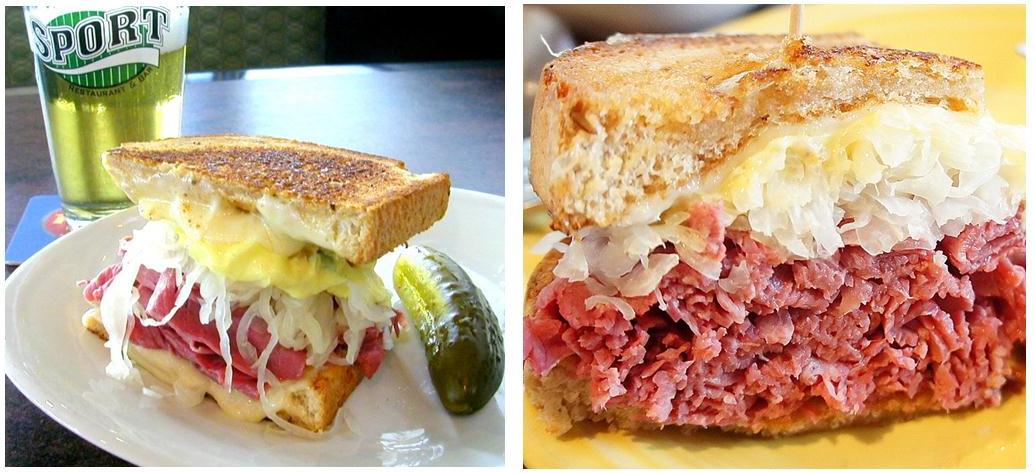
What a cute baby, the one on the left! But a baby after all. Young Reuben, back in August of 2005, already had many of the classic traits: caraway rye, Swiss cheese, pleasantly tangy sauerkraut, a "special sauce" that was more mayo than thousand-island, accompanied by a dill pickle. On the right, a look at that same sandwich earlier this week. Can you see the difference?
A first glance, the difference is obvious: more meat, much more. It's corned beef that Sport buys from a 95-year-old company in San Francisco, Columbus Meats. Half a pound of thin-sliced meat & trimmings (sauerkraut, cheese, "special sauce") on grilled, thick-cut rye bread. And don't forget the kosher dill.
Sidebar: the difference between pastrami and corned beef. These days, both are made from brisket, the former smoked, the latter brined. The distinctions get blurry. Pastrami ideally is made from a cut called "navel" (also known as "plate") and is generally fattier. But this is a field--Jewish deli meats of New York and "smoked meat" of Montreal--that one enters with trepidation. If you substitute pastrami for corned beef, it's no longer a Reuben but a Rachel. (Huh?)
"The sandwich [in the 2005 picture] was proably just made incorrectly," restaurant owner John Howie writes in an email. (Now he tells me.) Full Reuben is now $14, a modest increase from $11.95 seven years ago.
Did I mention that all this is at Sport, across from the Space Needle? There's a flatscreen TV at every booth, and it's okay to bring the kiddies. The GM these days is none other than owner John Howie's son, Eric.
Sport Restaurant & Bar, 140 4th Avenue N., Seattle, 206-404-7767
Labels:
panini,
restaurants
| Reactions: |
Saturday, March 31, 2012
Contanti is king
| Valentino on Milan's Via Montenapoleone, hallowed ground for high fashion |
Now, this time-honored Italian tradition doesn't work where prices are clearly stated and there's nothing for merchant to gain by dropping the public price. But when it's a designer dress, or a piece of designer jewelry, then it's a different story. No credit card fees, nothing to declare.
Ah, but Italy's government is cracking down on tax evasion. It briefly banned 1,000-euro notes, then relented. Now the limit applies only to Italian citizens, leaving the big spenders alone. And who are they? Not us, not 'Merkins, nope. The big money's being spent by Chinese, Russian and Brazilian tourists, flush with cash and eager to buy designer labels in Rome, Milan and Venice.
Reuters reports on the problem here
Labels:
high fashion,
Milan,
retailing,
tourism
| Reactions: |
Thursday, March 15, 2012
Boeing's Italian Mistress
| Italian Alps, with Franciacorta vineyardes in the foreground |
But it's the high-tech manufacturing corridor that's in the news today. Boeing has just announced that the horizontal tail of its 787-9 Dreamliner will be manufactured not in Seattle (where the development work has been going on) but in Italy, at a factory owned by a subsidiary of Italy's giant Finmeccanica known as AleniaAermacchi.
Alenia (a species of skipper butterfly in Latin) already makes the horizontal tails for the 787-8 (the version of the Dreamliner that's currently under construction), but those parts, according to Seattle Times aerospace reporter Dominic Gates, produced "many quality issues and resulted in significant delays to the program."
Still, it appears that all is forgiven. "We try to have more than one source for parts and assemblies," a Boeing spokesman said. "When it is possible, we have a bias toward additional sourcing."
Alenia does more than just piece-work, however. Their latest plane, just released, is a trainer for the Israeli air force.
The company is headquartered Venegono Superiore, a town of 7,000 souls adjoining the northern Italian lake coutry about 35 miles northwest of Milan. One of its advantages: an airstrip that's longer than its main street, the via Finzi. The best restaurant in town is called La Pancia Piena (the full stomach), and specializes in unlimited portions of oversize gnocchi. Those Boeing inspectors, they'll need every foot of runway to get off the ground on their way home.
Labels:
Alenia,
Boeing,
Dreamliner,
Italy
| Reactions: |
Subscribe to:
Posts (Atom)